
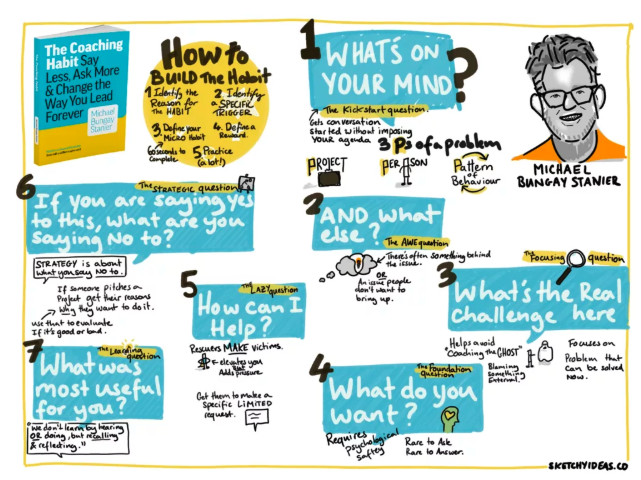
Well, that summed things up pretty famously. Nice work, SketchIdeas.com.
I picked this book up as I was assigned a management role with KPS3. I figured some additional knowledge would definitely help. Here’s’ the bullets:
- Intro:
- Do not train people to become overly dependent on you. Your team should be more than self sufficient.
- Continue to ensure your work makes an impact, even more of an impact now that you have help.
- To build a habit, you must have: a reason, a trigger, a micro-habit, effective practice, and a plan.
- When you practice, know how to practice well. Practicing small chunks of the bigger action shows more improvement. Then, repetition!
- We are what we give our attention to.
- We only pursue our own agendas. Yet, don’t know what we actually want.
- To sum it up: less advice, more curiosity, find your own questions, find your own voice, build your coaching habit.
- Silence – Good reminder to embrace it. 3-4 seconds is appropriate.
- Silence is a measure of success.
- Q1: What’s on your mind?
- Challenges are generally centered around the 3 P’s: people, projects, or patterns
- Q2: The awe question: And what else?
- Having 2 choices leads to bad decisions. Having a 3rd option can improve success. 5-7 is the max for options.
- This question can not only add another option, but also… buy time
- Q3: The focus question: What’s the real challenge here?”
- Don’t ask rhetorical questions with advice. “Have you thought about..”
- Ask “What’s the real challenge here?”
- Adding “… for you?” at the end of the question can focus more on development than performance. “What’s the real challenge here for you?”
- Q4: The foundation question: What do you want?
- Never ask the “Why” question? Always stick to “whats”
- When you’re brain is safe, it can act on a sophisticated level
- People want to work with you for the reward, not the risk:
- TERA:
- Tribe – are you with me?
- Expectation – do I know the future?
- Rank – Are you more or less important?
- Autonomy – Do I get a say or don’t I?
- TERA:
- Q5: The lazy question: How can I help?
- Doctors who asked how can I help? Rather than mention they heard they had a sinus infection. What would be best is this…
Those that were more general, got better ratings and better feedback. - Watch out for being the rescuer… Always jumping in and fixing. Then people reject wanting to work with you. Don’t let the victims and persecutors do their thing. Just ask.
- Doctors who asked how can I help? Rather than mention they heard they had a sinus infection. What would be best is this…
- Q6: The strategic question: If you’re saying yes to this, what are you saying no to?
- Being busy is actually lazy? Lazy thinking and ways to say no to things.
- The essence of strategy is choosing what not to do.
- A yes is nothing without the NO
- Say yes more SLOWLY
- Q7: The learning question: What was the most useful for you about this conversation?
- People learn when they recall and reflect on what just happened.
- People forget everything once they walk out of a corporate classroom.